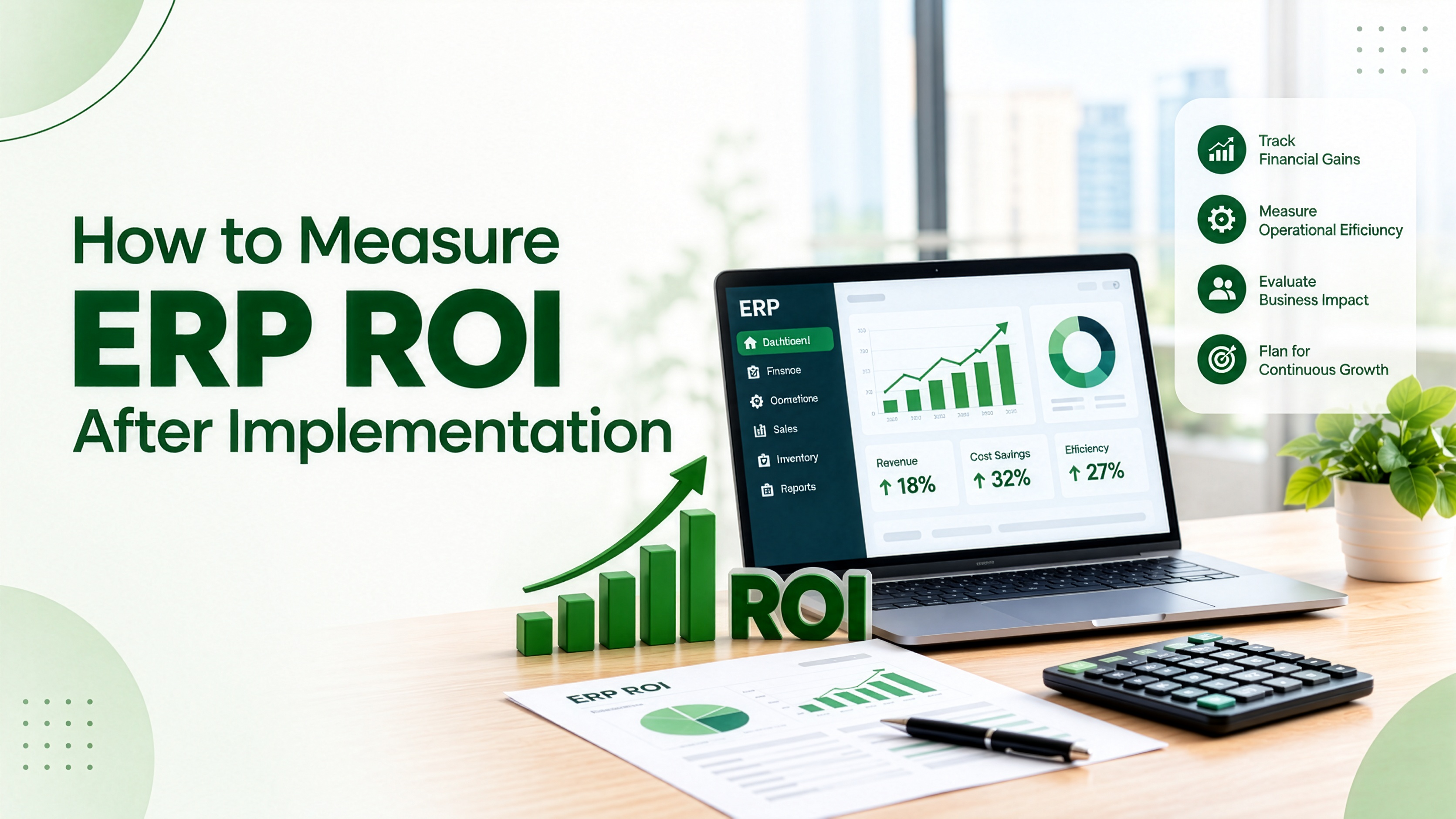
How to Measure ERP ROI After Implementation: 7 KPIs That Matter
Your ERP is live. Your employees are using it. But is your business actually getting a return on the investment?
Many businesses consider ERP implementation successful once the system goes live.
But going live is a milestone. Business improvement is the real goal.
Whether you are using ERPNext, SAP, Odoo, or another ERP solution, measuring Return on Investment (ROI) helps you understand whether your ERP is delivering genuine business value.
Here's how to measure it.
What Is ERP ROI?
ERP ROI (Return on Investment) measures the financial value your business gains compared to the total cost of implementing and operating the ERP.
The basic formula is:
ERP ROI (%) = [(Total Financial Benefits − Total ERP Costs) ÷ Total ERP Costs] × 100
For example, imagine a business spends ₹20 lakh implementing and operating an ERP over two years.
During the same period, it achieves:
- ₹10 lakh in operational cost savings
- ₹8 lakh in inventory carrying-cost savings
- ₹12 lakh in other measurable productivity and process improvements
Total Benefits: ₹30 lakh
Total ERP Cost: ₹20 lakh
ERP ROI = 50%
This means the business generated ₹10 lakh in net measurable value over the two-year period.
This is an illustrative example, not a customer result. Savings must be supported by actual business data and should not be double-counted.
But calculating ROI is only the beginning.
7 KPIs to Measure ERP Success After Implementation
1. Operational Efficiency
Are your employees completing tasks faster than before?
Measure the time required for order processing, invoicing, purchase approvals, and other routine activities.
Example: Reducing order processing time from 20 minutes to 8 minutes.
2. Inventory Accuracy
ERP should help businesses maintain better stock visibility and minimize inventory errors.
Track stock discrepancies, stockouts, excess inventory, and inventory carrying costs.
A good ERP should help you make better inventory decisions, not simply record stock movements.
3. Financial Reporting Time
How long does your finance team take to generate accurate monthly reports?
If reporting previously required several days of manual consolidation, ERP should help reduce that effort.
Track month-end closing time, reporting hours, and reconciliation errors.
4. Employee Productivity
Measure whether employees spend less time on repetitive tasks, duplicate entries, and manual reconciliation.
Remember: time saved becomes a measurable financial benefit when it reduces actual costs or creates additional productive capacity with a defensible value.
5. Order Fulfilment Performance
ERP should improve coordination between sales, purchasing, inventory, and delivery teams.
Track:
- On-time delivery percentage
- Order processing cycle time
- Order fulfilment errors
6. Customer Satisfaction
Better operational visibility can lead to faster responses and fewer service delays.
Measure customer complaints, order accuracy, response times, and repeat purchases.
These indicators help determine whether ERP improvements are reaching your customers.
7. User Adoption Rate
An ERP cannot deliver its full value if employees continue relying on disconnected spreadsheets and manual processes.
Track active users, transaction completion inside ERP, and the percentage of business processes consistently handled through the system.
Low ERP adoption often means unrealized ERP value.
When Should You Measure ERP ROI?
ERP ROI should not be measured only once.
Start with baseline measurements before implementation, then review performance at important stages.
Timeline What to Measure
Before Implementation Existing costs, process time, accuracy, and productivity
30 Days After Go-Live System stability and user adoption
90 Days Initial operational improvements
6 Months Efficiency gains and measurable cost reductions
12 Months Financial returns and performance improvements
Annually Long-term ROI and optimization opportunities
While these timelines are useful checkpoints, meaningful financial ROI may take longer to materialize depending on the business and implementation scope.
The Biggest Mistake Businesses Make
One of the biggest mistakes is measuring ERP success based only on whether implementation was completed on time and within budget.
A project can meet both targets and still fail to produce meaningful business improvements.
The real questions are:
Are processes faster? Are operating costs lower? Is management getting better visibility? Are employees actually using the ERP effectively?
If these improvements are not happening, the business should review process design, system adoption, integrations, training, and reporting requirements.
Final Thoughts: ERP Success Begins After Go-Live
Digital transformation is not complete when ERP software starts running.
It becomes valuable when the business achieves measurable improvements in efficiency, control, visibility, and profitability.
At LABOFWEB we believe ERP implementation should focus on business outcomes not just software deployment.
Your ERP is live. But is it delivering measurable results?
Let's evaluate how your ERP can create greater business value.
Visit www.labofweb.com to connect with our ERP consulting team.
Ready to Elevate Your Digital Operations?
Whether you need custom ERP solutions, web & mobile applications, or sustainability management, our expert team is here to help you scale efficiently.